
I have written before about how much the Fed matters to crypto, and this week was a good illustration. Bitcoin made a new all-time high on Tuesday and was down the best part of 10 per cent from it by Thursday morning, and the thing in between was a Federal Reserve meeting that did exactly what everyone expected it to do.
What happened
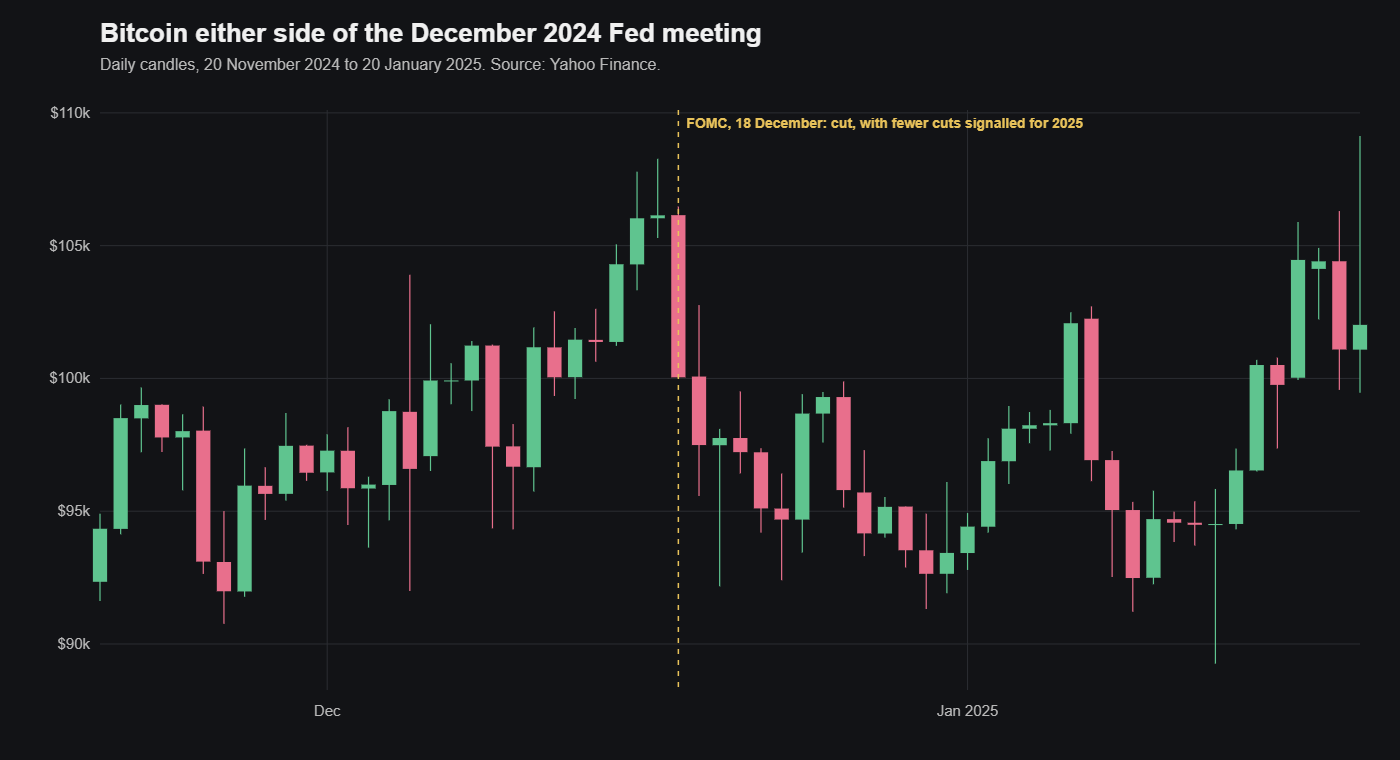
On 18 December 2024 the FOMC cut rates by a quarter point, to a range of 4.25 to 4.5 per cent. That was fully priced and on its own would have moved nothing. What moved markets was the forward guidance. The committee’s projections showed only two further cuts in 2025 where the previous set had shown four, and Jerome Powell was clear in the press conference that the Fed wanted to see real progress on inflation before easing further. The market had been hoping for a softer message and did not get one.
Equities sold off hard, with the S&P 500 and the Russell 2000 both down sharply on the day. Bitcoin, which had touched roughly $108,000 the day before, fell to around $98,800 in the hours after the announcement. By Thursday morning it was trading near $102,400, down about 2.5 per cent on the day, with an intraday range of roughly $98,800 to $105,300. That is a wide range even by Bitcoin’s standards, and it tells you the market has not decided what it thinks yet.
Powell was also asked directly about Bitcoin and said the Fed is not permitted to own it and is not seeking a change in the law. There had been a certain amount of speculation about a strategic reserve of some kind, and that answer took some of the air out of it.
Why I think this is an interim top
Two reasons, and neither is about the long-term case for Bitcoin, which I am not trying to argue here one way or the other.
The first is liquidity. Crypto is the most liquidity-sensitive asset class there is. The rally from the autumn was built in part on the expectation that rates would keep coming down through 2025, and the Fed has just said they will come down more slowly than that. Less easing means less liquidity, and less liquidity means the marginal buyer who was leaning on cheap funding to hold a position has less reason to. That does not end a bull market, but it takes the urgency out of it.
The second is positioning. In the week before the meeting Bitcoin rallied on the hope of a dovish surprise, and a good deal of that buying was from people who were planning to sell into the event whatever it said. When the event turned out to be hawkish, they had both a reason and an excuse. Sell the news is a cliché because it keeps happening, and it keeps happening because the people who bought in anticipation have to get out through the same door.
An interim top is not a crash call. It means I expect a period of consolidation, probably a range with the recent high as the ceiling, while the market works out how much of the rally was rates and how much was something else. If the something else, which is mostly ETF flows and the prospect of friendlier regulation, is as strong as its supporters think, the range resolves upward in time. If it was mostly rates, it does not.
What to watch
The inflation data, because that is what will decide whether the two cuts the Fed is now projecting become three or one. The ETF flows, because they are the cleanest reading of whether real money is buying this dip or stepping back. And the range itself: a close above $108,000 on volume would say I was wrong, and a break below the $92,000 area, which is roughly where the last leg of the rally started, would say the consolidation is turning into something worse.
The general point, which I keep making, is that anyone holding Bitcoin needs to pay as much attention to the Fed as to anything on-chain. A central bank that controls the price of money controls the price of everything that competes with money, and for the time being Bitcoin trades as if it knows that.