
I get asked this more than anything else. Usually by someone who has seen an advert for a course, or watched a video of a man in a rented car explaining his method, and wants to know whether I could just show them what to do. The honest answer is no, not in the way they mean, and I would rather explain why than just say it.
There is no method. Or rather, there are hundreds, and none of them is the thing that separates the people who last from the people who do not. What separates them is how they handle being wrong, and that cannot be taught in a weekend because it has to be learned by being wrong, repeatedly, with your own money, and noticing what you did next.
The courses that promise otherwise are selling something, and what they are selling is the feeling that trading is a skill like driving, where a few lessons and some practice get you there. Most of the people running them have never traded professionally, which is why they can promise it with a straight face. Anyone who has sat on a desk through a bad quarter knows that the method is the easy part. I can explain how to read a chart in an afternoon. I cannot explain how it feels to watch a position go against you for three weeks while every rule you have says to hold it, and that is the lesson.
So if someone is serious, this is what I tell them. Learn how the markets actually work first, meaning how prices are formed, who the participants are, what moves what and why, before you look at a single indicator. Learn enough of both fundamental and technical analysis to know what each one can and cannot tell you. And then spend most of your effort on the only subject that matters, which is risk: how big a position should be, where you get out, how much you can lose in a day before you stop, and how to make sure one bad trade cannot end you. Everything I write on this site under volatility, correlation and position sizing is really about that one subject.
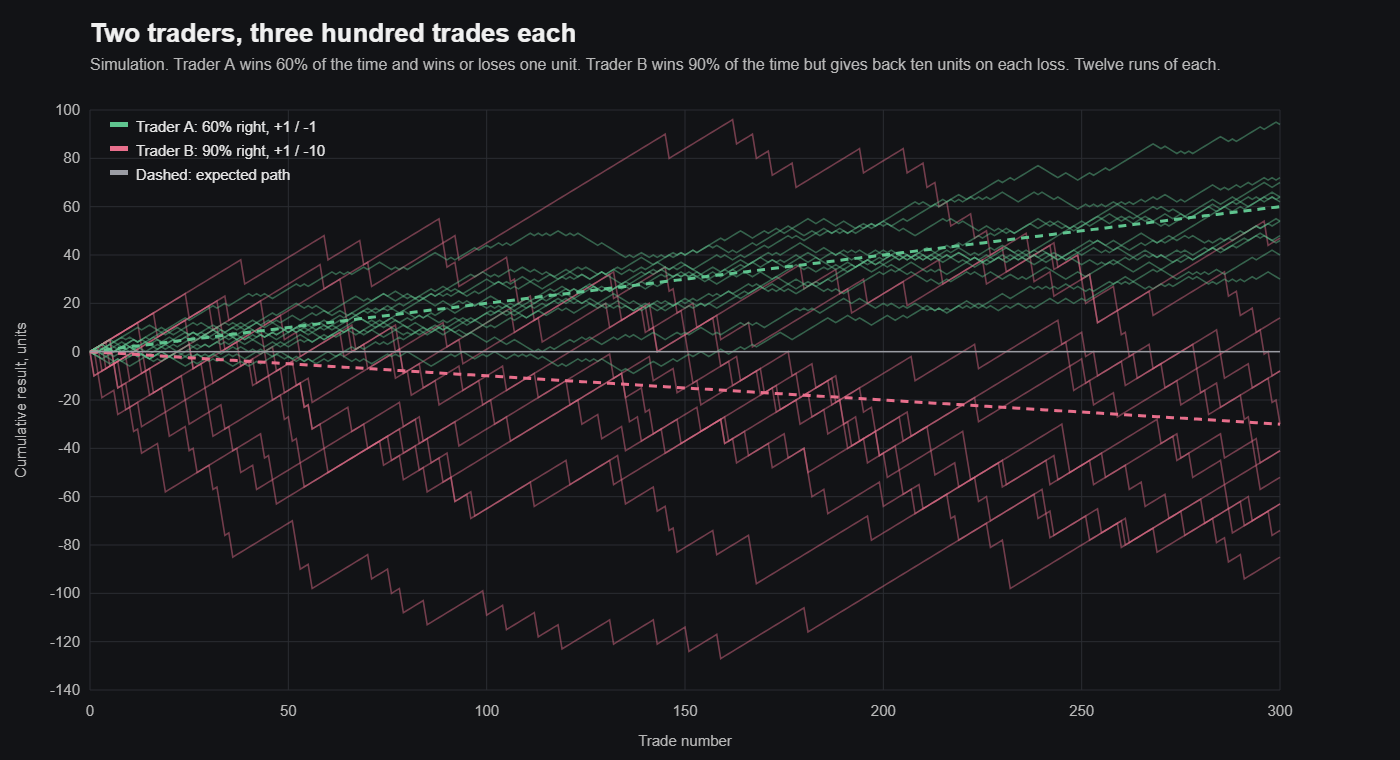
Losses are not a sign that it is going wrong. They are the cost of finding out, and the aim is not to avoid them but to make sure they are smaller and less frequent than the wins over a long enough period to mean something. A trader who wins six times out of ten and loses the same amount each time they lose is doing very well. A trader who wins nine times out of ten and gives it all back on the tenth is not trading, they are gambling with extra steps.
The people I have seen do well treat it as a business. They keep records. They review the bad trades more carefully than the good ones. They assume they will be at it for years, so they do not need any one trade to work. And they have a reason for every position that they could explain to someone else without embarrassment, which is a surprisingly good test.
I will be writing about risk management here in some detail, because it is the part that is actually teachable, and because it is the part that nobody selling a course wants to talk about. If you only read one thing before you place a trade, read that.