
A hundred grams of plain frozen açaí pulp contains about 58 calories, 3.9 g of fat, 6.2 g of carbohydrate and 0.8 g of protein. Those are the figures in TACO, the Brazilian food composition table published by the food research centre at Unicamp (as reproduced by Tabela TACO Online). The same table has a second entry for açaí pulp mixed with guaraná syrup and glucose, which is a common way of selling it in Brazil: about 110 calories and 21.5 g of carbohydrate per 100 g. The fat and protein barely move. The extra carbohydrate is the syrup.
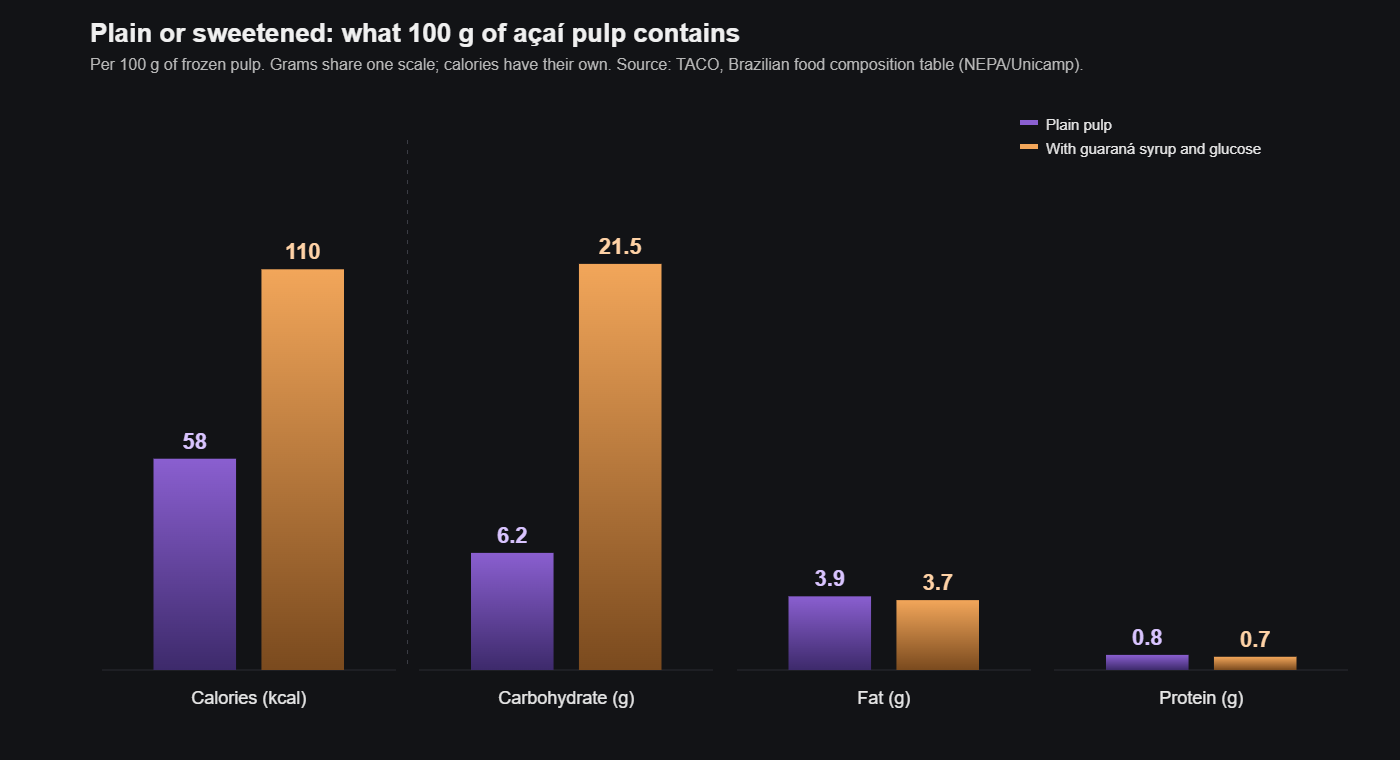
Those two rows explain most of the confusion about açaí. People hear that it is a healthy fruit, then read that an açaí bowl has as much sugar as a dessert, and both are true, because they are describing different things. I spend a lot of time around this product, and I have written before about where it comes from. This piece is about what it actually is once it gets here, and about some of the things it is sold as that it isn’t.
It is a fatty fruit, which surprises most people
Work the TACO numbers through and something unusual comes out. Fat has about nine calories a gram, so 3.9 g of fat is roughly 35 of the 58 calories in plain pulp, or about 60% of its energy. Most fruit gets almost all of its energy from sugar. Açaí, in that respect, has more in common with an olive or an avocado than with a blueberry, which is the fruit it usually gets compared to because of the colour.
The fat is mostly the same kind that is in olive oil. A 2024 study in Frontiers in Nutrition extracted the oil from purple açaí pulp and found it was 62% oleic acid, with palmitic acid at about 22% and linoleic acid at about 10%. That is an interesting profile for a fruit, and it is one reason the plain pulp tastes earthy and slightly savoury rather than sweet. In Pará it is often served unsweetened with fish or cassava flour, and it makes sense once you know it is closer to an oily fruit than a berry.
The colour comes from anthocyanins, the same family of pigments that makes blackcurrants and red cabbage purple. The main ones in açaí are cyanidin-3-glucoside and cyanidin-3-rutinoside. The pulp is dark enough to stain almost anything it touches.
It is low in sugar until someone adds some
Plain pulp has 6.2 g of carbohydrate per 100 g, and not all of that is sugar. That is very little for a fruit, and it is why açaí so rarely reaches the customer plain. In much of Brazil it is sold mixed with guaraná syrup. The frozen packs sold abroad come both sweetened and unsweetened, and a bowl then adds banana, granola, honey or other fruit on top.
None of that makes a bowl a bad thing to eat. It makes it a dish, with the nutrition of everything in it, and the açaí itself is usually the least sugary part. If you want to know what you are eating, the ingredient list on the pack tells you most of what matters. If sugar, syrup or glucose appears, it is sweetened. If açaí, and perhaps water, is all that is listed, it is the plain pulp.
The antioxidant scores you see quoted are not worth much
For years açaí was marketed with ORAC scores, a laboratory measure of how well a substance neutralises free radicals in a test tube, and açaí scored very high. In 2012 the US Department of Agriculture removed its own ORAC database from its website. It said the values were “routinely misused” by food and supplement companies, and that antioxidant capacity measured in a laboratory could not be extrapolated to effects in the body (reported at the time by SupplySide). A high number in a test tube tells you about chemistry. It doesn’t tell you what happens after you eat it.
That doesn’t mean the anthocyanins do nothing. It means the number on the label isn’t evidence that they do anything in particular, and the honest answer is that the research in people is still thin.
What the research in people actually shows
The US National Center for Complementary and Integrative Health keeps a plain-language page on açaí, last updated in November 2024. Its summary is that very little research has been done in people, and that there is not enough reliable information to say whether açaí helps with any health-related purpose. It adds that no human studies published in peer-reviewed journals in the previous five years support claims that açaí helps with weight loss, and that the US Federal Trade Commission has taken action against companies that marketed açaí weight-loss products in ways it alleged were deceptive.
A Brazilian systematic review published in February 2025 found 12 human studies that met its criteria. Most of those that measured markers of oxidative stress or inflammation reported some improvement. None of the six that looked at blood sugar found a benefit. The authors describe the studies as heterogeneous and ask for larger trials with standardised doses. Read together, that is a reasonable place to leave it: some promising signals, small studies, nothing that would justify a health claim.
“Superfood” is a marketing word, and in the UK it is a regulated one
There is no nutritional category called superfood. It is a description, and the advertising rules treat it as one. The UK’s advertising regulator lists “superfood”, “superfoods” and “super fruit” among its examples of general health claims. Under the rules that came from the EU nutrition and health claims regulation, a general claim like that can only be used in marketing if an authorised specific health claim sits right next to it, and the product has to meet the conditions for that specific claim. On a website, the specific claim has to be on the same page.
I think that is a sensible rule, and it pushes in the right direction. It is much more useful to tell a customer what is in a bowl than to tell them it is super.
What it is, then
A fruit from the Amazon estuary with an unusual amount of fat, most of it the olive-oil kind, a great deal of colour, and very little sugar of its own. It spoils within a day of being picked, which is why most people outside the Amazon eat it frozen. It is traditionally eaten plain, and elsewhere it is often sweetened. There is one genuine safety point, and it is about processing rather than the fruit: raw, unblanched juice has occasionally been linked to Chagas disease, which is why Pará requires blanching in its pulp shops. I explained that step in the piece on the supply chain.
If you buy it to eat at home, check three things on the pack: whether anything has been added to sweeten it, the grade if it is given (the thicker grades have less water in them), and the serving size the nutrition panel is based on. Those three tell you more about what you are getting than any word on the front of the pack.