
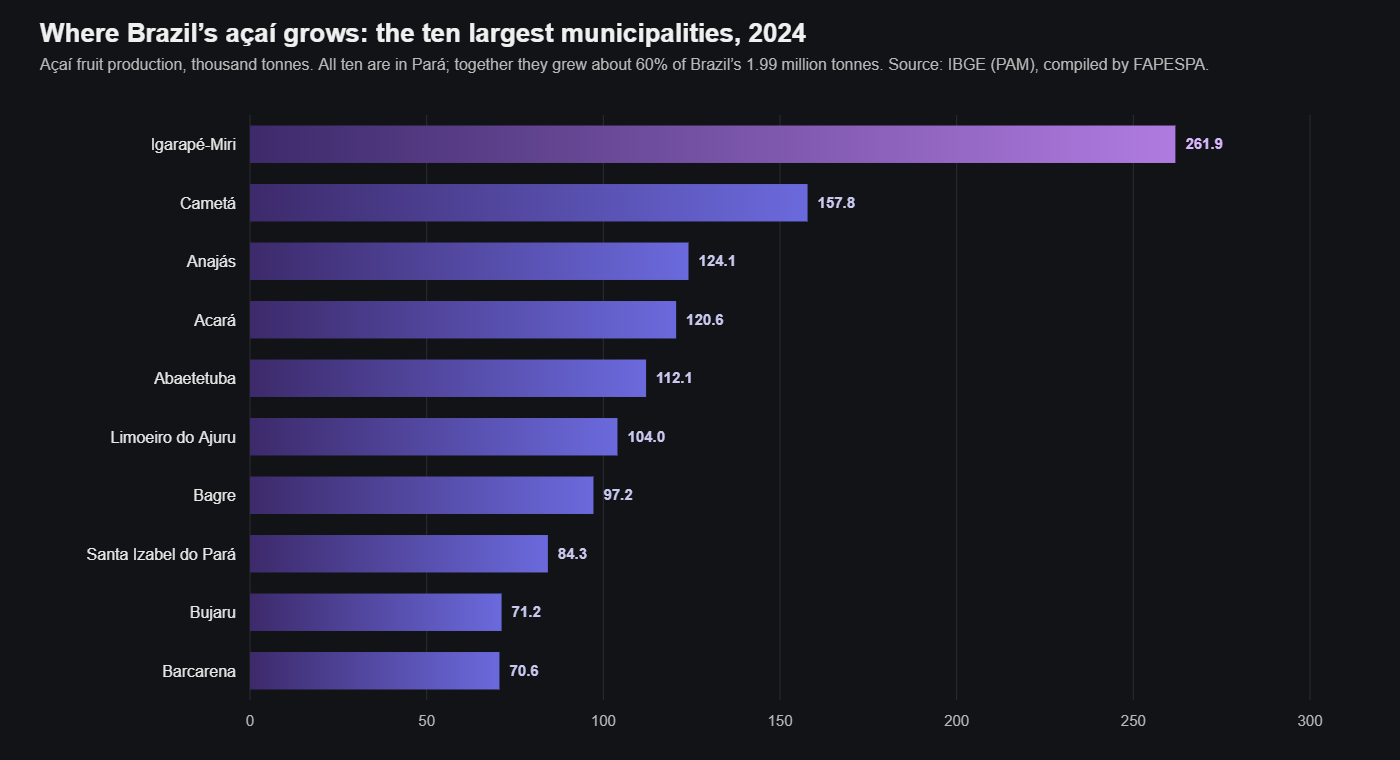
Nearly all of Brazil’s açaí comes from one state. The country grew just under two million tonnes of the fruit in 2024, and 89.5% of it came from Pará, according to IBGE figures compiled by FAPESPA, the state’s research foundation. Ten municipalities in Pará grew about 60% of the national crop between them. Igarapé-Miri, a river town south-west of Belém, grew more than 260,000 tonnes on its own.
When someone asks me where the açaí in a London bowl comes from, that is the short answer. The longer one is a chain with half a dozen links, and most of what matters about the product is settled before it gets anywhere near a freezer in Britain: what it costs, how thick it is, how it tastes and whether it is safe to eat. My side of Acai Berry Foods is the finance, and I have found that I can’t read our numbers properly without knowing what happens at each of those links. I have written about the money side of the shops before. This is the part that happens before the shops.
It is picked by hand, from the top of a palm
Açaí is the fruit of Euterpe oleracea, a slender palm that grows in clumps on the floodplains of the Amazon estuary. The fruit hangs in heavy bunches just below the crown of leaves, and the traditional way of reaching it has hardly changed. The harvester twists a palm leaf into a loop called a peconha, puts both feet through it and climbs the bare trunk. The bunch is cut and brought down, and the small, almost black fruit are stripped from it on the ground. That step is called the debulha. CNN Brasil spoke to a harvester on Ilha do Cumbu, one of the islands across the bay from Belém, who was 68 and had been climbing since he was ten.
That is still how a great deal of açaí is picked, though the numbers have moved on. Of the 1.99 million tonnes Brazil produced in 2024, Conab counts 1.74 million as cultivated and about 247,000 as extractive, meaning gathered from wild stands. The area of planted açaí in Pará went from roughly 135,000 hectares in 2015 to about 252,000 in 2024. The romantic version of the supply chain is a man on a palm. The statistics now count most of the crop as a cultivated one.
The crop comes in the second half of the year
Embrapa, Brazil’s agricultural research agency, puts 70 to 80% of Pará’s production between July and December. January to July is the entressafra, the off-season, when there is much less fruit and the price goes up. You can watch it happen in the data. Conab tracks what extractive harvesters are paid each month, and in the first quarter of 2026 the price in Pará went from R$5.11 a kilo in January to R$9.66 in March, a rise of 89% in two months. The government’s minimum price for extractive açaí this year is R$2.28 a kilo, so in the off-season the market pays several times the floor.
Embrapa’s response to the gap has been breeding and irrigation. Açaí planted on terra firme, the higher ground away from the floodplain, and watered through the dry months, can fruit when the várzea palms don’t. It evens out the calendar a little. It hasn’t got rid of the season, and anyone buying açaí at the other end of the world is still, indirectly, buying a crop that peaks between July and December.
There are about 24 hours to work with
Açaí spoils quickly once it is picked. Sebrae’s market bulletin on açaí says the fruit has to be processed within 24 hours of the harvest, and that one fact shapes the whole first half of the chain. Producers often harvest the fruit and take it by boat themselves to a wholesale market, usually at a port. Middlemen, the atravessadores, also buy fruit while it is still on the palm and do the harvesting and the debulha themselves. The buyers at those markets range from the small pulp shops that serve a single street to the large processors that freeze for export.
The same bulletin gives a useful yield: about 20 litres of pulp from a 50 kg sack of fruit. That makes it possible to work out the raw cost. At the March 2026 price, a 50 kg sack cost about R$483 at the riverbank, which is roughly R$24 of fruit in every litre of pulp, before anyone has paid for processing, freezing, freight or a margin. In January the same sack would have cost about R$256, or under R$13 a litre. The fruit cost of a litre of açaí can nearly double within a single quarter, for reasons that have nothing to do with anyone in London.
How the fruit becomes pulp, and why the grade matters
The part you eat is a thin layer of purple flesh around a hard seed. In a processing plant, or in a batedeira, the small machine shop that makes pulp for the neighbourhood, the flesh is separated from the seed mechanically, with water added, and the result is filtered. What comes out is a thick purple liquid, and how thick it is happens to be a matter of law. Brazil’s agriculture ministry set three grades in 2000, in Instrução Normativa nº 1, defined by the share of total solids (summarised by Embrapa here):
- açaí grosso or especial, type A: more than 14% solids
- açaí médio or regular, type B: between 11% and 14%
- açaí fino or popular, type C: between 8% and 11%
The difference between the grades is mostly water. If you are comparing prices between two suppliers, the grade is the first thing to check, because a cheaper litre of fino can simply be a litre with more water in it. A per-litre price only means something once you know how many litres of açaí are actually in it.
The safety step most people outside Brazil have never heard of
Pará has a public-health reason to be careful with açaí. Chagas disease is caused by a parasite, Trypanosoma cruzi, carried by an insect Brazilians call the barbeiro. If an infected insect, or its droppings, gets crushed along with the fruit, the parasite can end up in the pulp and the infection can be passed on by mouth. Embrapa notes that between 2007 and 2013 Pará accounted for 75% of the Chagas cases recorded in the Legal Amazon.
The remedy is simple and cheap. Since 2012 Pará has required blanching in artisanal pulp shops and in any processor that doesn’t pasteurise the pulp: the whole fruit goes into water at 80°C for 10 seconds and is cooled straight afterwards, before it is pulped. According to Embrapa it doesn’t change the flavour. Pasteurising the finished pulp is the other route, and under the federal standard pasteurisation is optional, which is exactly why the blanching rule matters. If I were taking on a new supplier, this is one of the first questions I would ask: which of the two do you do, and can I see the paperwork for it?
Most of it never leaves Brazil
Pulp made for export is frozen and has to stay frozen from the plant to the customer: refrigerated trucks to the port, a refrigerated container on the ship, a cold store at the other end. In 2025 Pará exported about 35,100 tonnes of açaí products worth about US$127.8 million, according to FAPESPA’s estimate from federal trade data, at an average of roughly US$3.60 a kilo. In 2002 the same figure was 298 tonnes. The United States is by a wide margin the largest buyer, followed by Japan and Australia, according to the trade centre of FIEPA, the state’s industry federation, as reported by Diário do Pará.
Put the exports next to the harvest and the striking thing is how much of the crop stays at home. The two figures aren’t directly comparable, because one is whole fruit and the other is pulp and finished products, but the gap is too wide for that to explain it away. In Pará açaí is a staple, eaten every day and unsweetened, with fish or with farinha, the coarse cassava flour. The frozen breakfast bowl that most people in Europe know is a small export offshoot of something that is mainly a local food.
The London end
By the time it reaches a shop in London, açaí has been up a palm, down a river, through a port market, a pulping plant, a freezer, a ship and a cold store. Acai Berry Foods began as a market stall on Brick Lane and now has eight shops in London, four in the UAE and one in New York. Alongside the bowls it sells frozen Brazilian açaí in 500 ml tubs and 5 litre catering boxes, vegan and dairy free. I wrote separately about why London was the right first market.
From the finance side, the supply chain turns into three things I keep an eye on. The first is the season. A fruit price that can rise 89% in a quarter at source will reach the cost of a bowl sooner or later, and it is much better to plan for it in the budget than to discover it in the margin. The second is currency. The export trade is measured in dollars and our customers in London pay in pounds, so at least one exchange rate sits between the riverbank and the till, whether or not anyone is looking at it. The third is the cold chain at our own end. Frozen pulp that thaws and refreezes is stock you can no longer sell, and a single freezer failure at one site goes straight into the waste column. That is the column I wrote about in the piece on the shops, and it starts a long way upstream of the counter.